Fiat, gold, or Bitcoin?
· 37 min read
In this article, I would like to go through the advantages and disadvantages of the kinds of money mentioned above. I would like to explain to the reader the difference between money and currency, and what fiat actually is. Next, I would like to show the history of the US dollar and its transition from the gold standard to fiat money, and then we will compare fiat money with gold. Finally, we will focus on Bitcoin, how and why Bitcoin came to be and a little bit of how it works. We will compare fiat, gold, and Bitcoin, and then take a closer look at the advantages, disadvantages, and myths of Bitcoin.
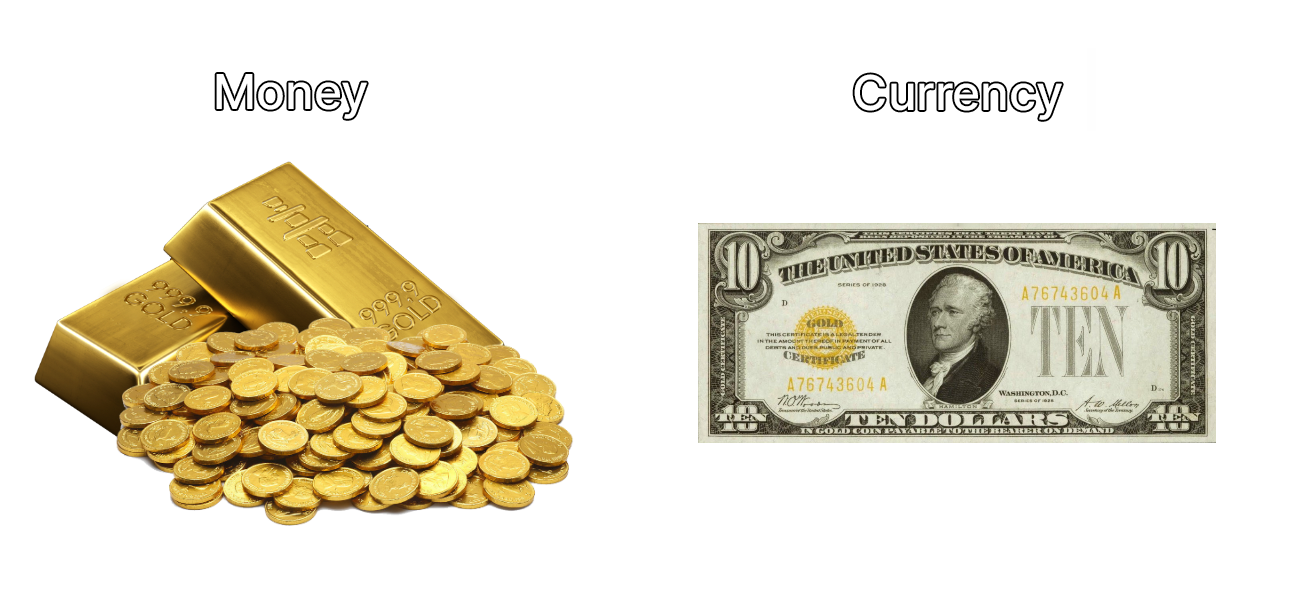
Money and currency
Before explaining the difference between money and currency, let's look at their individual functions.
Money - functions
- Store of value
- Medium of exchange
- Unit of account
Currency - functions
- Convertibility
- Medium of exchange
- Unit of account
As you can see, money differs from currency in being a store of value; money can be gold, for example. But why gold? It's simple, gold is scarce (there is a limited amount of it on Earth), durable (it doesn't spoil), verifiable (hard to counterfeit), divisible, and transferable. Historically, gold has simply proven to be the best money and a very good store of value.
Currency, on the other hand, excels in convertibility, currency can be exchanged precisely for money. A historical example is banknotes (currency) that could be exchanged for gold (money). Currency was created to make daily payments easier.
Both money and currency can be a medium of exchange. Inconvenient barter was replaced by trade in which you can pay with money or currency. In the past, either with gold coins (money itself), or with banknotes (currency that could be exchanged for gold at a bank).
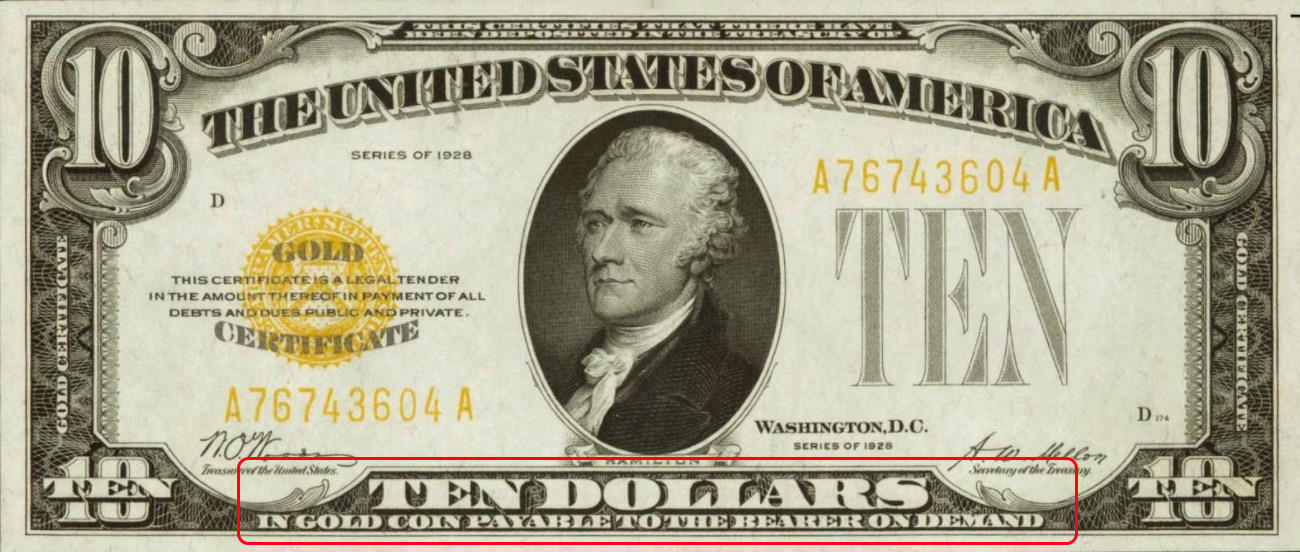
A ten-dollar bill from 1928, notice what it says: "Ten dollars in gold coin payable to the bearer on demand."
Fiat - deformation of functions and concepts
The magic word "fiat" appears already in the title of this article, and in my experience a lot of people don't know what it means, or have never even heard it. The fact that they have never even heard it is indeed something to think about.
The word fiat comes from Latin (fiat - "let it be done") and in English it means a decree or an order. From this follows (from my point of view) the first disadvantage, and that is the obligation, the absence of voluntary use.
The moment money is not voluntary, but is money with forced circulation (the definition of fiat), the first fatal problem arises, and that is its value. How much of such money will be in circulation is not decided by the market, but by some officials, so the value of fiat rests mainly on people's trust in these officials. And as we know from history, what is in the hands of officials usually doesn't turn out well, but more on that in the history of the US dollar.
It is not a requirement for fiat, but in practice it is like that all over the world - fiat is not backed by anything, neither gold nor silver, it's just paper (nowadays mostly in electronic form). On top of that, most central banks do inflation targeting, typically 2% per year. This means that a central bank deliberately aims for prices to rise by roughly 2% every year, so every banknote loses part of its purchasing power every year. The money supply grows even faster, in the US it has grown by roughly 7% per year on average since 1971 (measured by the M2 aggregate). The store of value function of money is thus fading away in the long run.
Currency (paper, a banknote) is not backed by any money (gold), so currency suddenly loses its convertibility function and turns from currency into mandatory money.
Fiat has completely distorted the concepts of currency and money. Because of the facts above, it is not even possible to say whether fiat is currency or money, because fiat is neither a long-term store of value nor convertible.
United States dollar
The situation before the dollar
Paper money in colonial times
A very interesting event for us is the battle for the French colony of Quebec, which was attacked by the English colony of Massachusetts in 1690. The battle ended very badly for Massachusetts, instead of a share of the spoils the soldiers barely survived, and the colony's administrators were facing the problem of a mutiny of unpaid soldiers.
However, the colonial administrators solved this problem very well indeed (from their point of view), they printed paper notes for the soldiers that could be exchanged for money (gold or silver) in the future. In reality, the notes could not be exchanged for money, paper money became popular, and the number of new notes increased rapidly.
With the growing amount of unbacked paper money (fiat) in circulation, price inflation eventually rose too, by 1750 the inflation in Massachusetts had reached (cumulatively) approximately 1000%. Such inflation can only be ended by stopping the printing of money.
Massachusetts finally did that in 1750 - it withdrew the paper money from circulation and redeemed it in silver, which it had received from Britain as compensation for the costs of the expedition against the fortress of Louisbourg (1745). The return to hard money did not cause any crisis, on the contrary, trade revived. The British Parliament then prohibited the colonies from issuing paper money as legal tender with the Currency Acts (1751 for New England, 1764 for all colonies). As you surely know, the colonists were not very fond of England itself, and these acts were among their grievances before the revolution. But the colonies returned to what was best, gold and silver.
American Revolutionary War - 1775
For Americans, the most important war in history, thanks to which the United States of America became an independent country. It is certainly an interesting historical event, but this article is mainly about money.
It is good to realize that printing new banknotes does not create wealth, it merely transfers wealth from the hands of society to the hands of whoever prints them. This is typical of every war, since people would almost never voluntarily start and pay for a war, statesmen simply have to take the money to finance the war from the rest of society.
They can take the money either through taxes or precisely by printing new paper. States usually choose to print new money, because whoever wants to be in power has to be a populist and raising taxes is not a very populist move. Printing new money, on the other hand, doesn't bother so many people, since they don't see that you are taking money directly from their paycheck, as happens with taxes.
So the Americans started printing the so-called continentals, which were initially defined as 1 continental = 1 Spanish (silver) dollar.
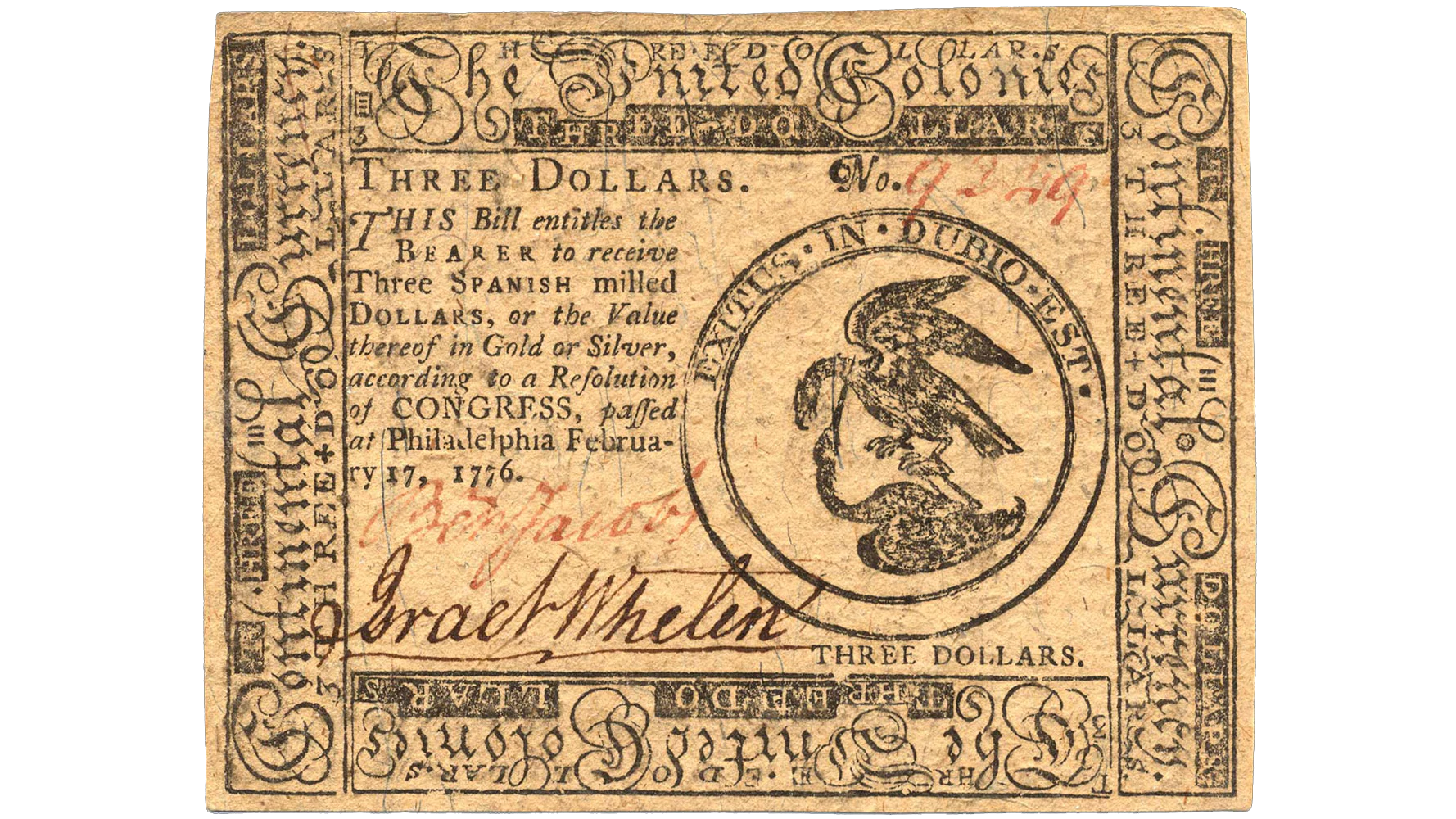
At the start of the war in 1775 the money supply was 12 million dollars, the Americans won the war in 1783, but the money supply was no longer 12 million dollars, but several hundred million dollars, 1 continental was no longer equal to 1 silver dollar, but only to about a hundredth of it, so again high inflation and a big devaluation of savings held in paper money. The only positive thing was the independence of the US.
Origins of the dollar - 1785
In 1785, Thomas Jefferson convinced the Congress of the Confederation to make the dollar the official monetary unit. Interestingly, it was not the American dollar, but the Spanish one. One Spanish dollar was defined as 24.443 grams of silver and was already quite popular in the colonies.
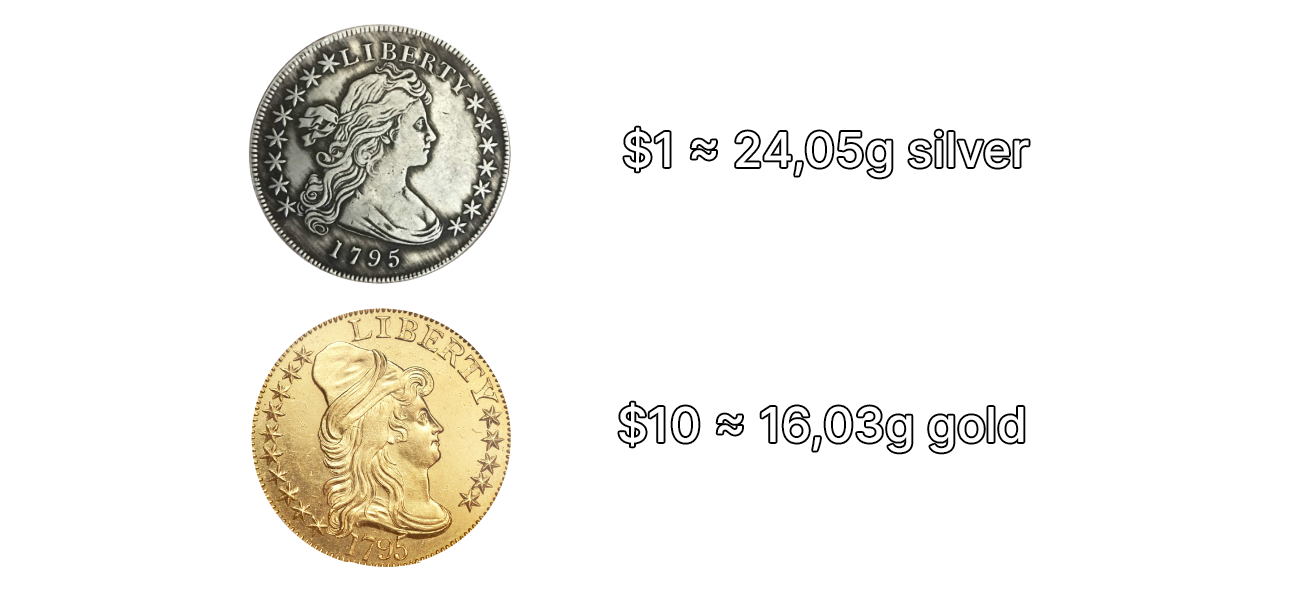
Congress had not forgotten all the paper hyperinflations of the pre-war and war periods, and it also feared dependence on Spain, so it later (with the Coinage Act of 1792) defined its own US dollar, at approximately 24.05 grams of silver. The Constitution of 1787 had moreover already prohibited the states from issuing paper money and from making anything but gold and silver coin a legal tender.
In 1791, a constitutional safeguard was added in the form of the Tenth Amendment - the federal government has only the powers delegated to it by the Constitution.
Bimetallism - 1792
The fatal mistake of the dollar was the introduction of so-called bimetallism, a double monetary standard - gold and silver.
Besides the silver dollar, there was a justified demand for gold coins as well. With gold coins, however, there were concerns that they might be debased in the future, as was customary throughout the history of silver and gold coins (examples include the denarius, aureus, and solidus).
Congress came up with a solution that seemed right at first sight - it precisely defined a gold coin too, the so-called eagle, worth 10 dollars, that is 10 silver dollars.
Ratio problem
As written above, Congress, with good intentions, also defined the gold dollar. However, we run into one big problem - gold and silver do not have a stable market price relative to each other.
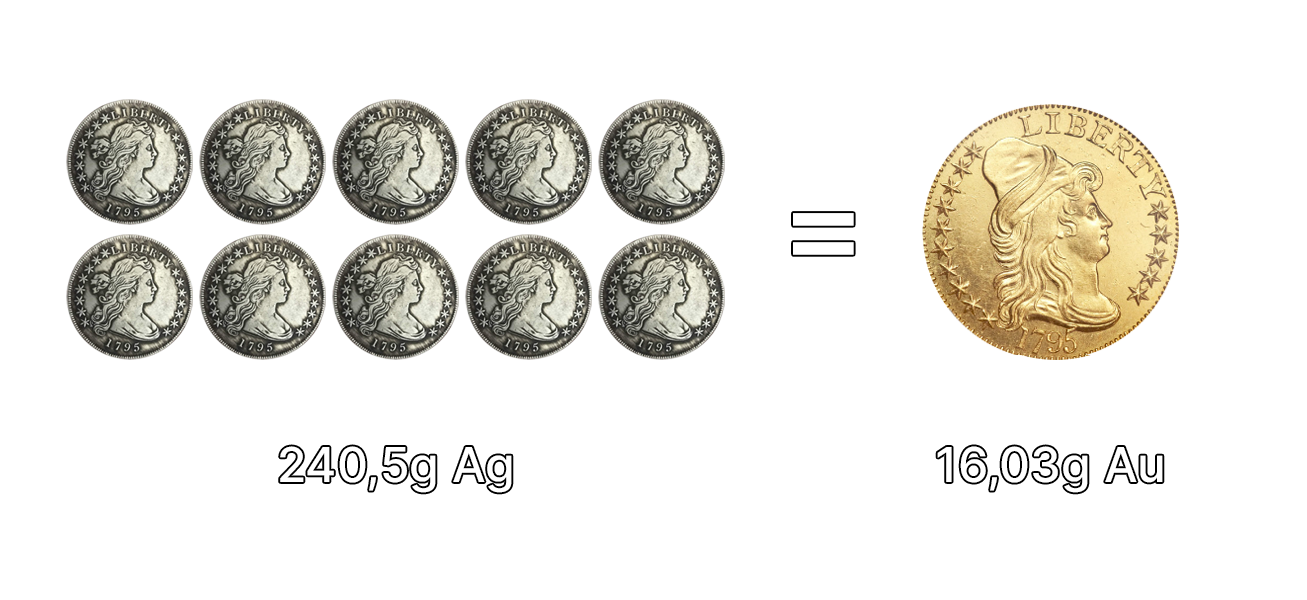
10 silver dollars contained 240.57 g of silver, the gold eagle 16.04 g of gold:
At that time gold was 15 times more expensive than silver, which is exactly why Congress defined silver and gold dollars at a ratio of 15:1.
Gresham's law
This law says that bad money drives out good money, or more precisely overvalued money drives out undervalued money.
Gresham's law showed itself in practice precisely from 1792 to 1873. It showed itself because the fixed ratio set by Congress always differed from the market one.
Typically, gold rushes changed the gold-silver ratio rapidly, for example, because of the famous California gold rush, the ratio of gold and silver changed in favor of silver. As a result, silver money began to disappear from circulation, while gold money came into wide use.
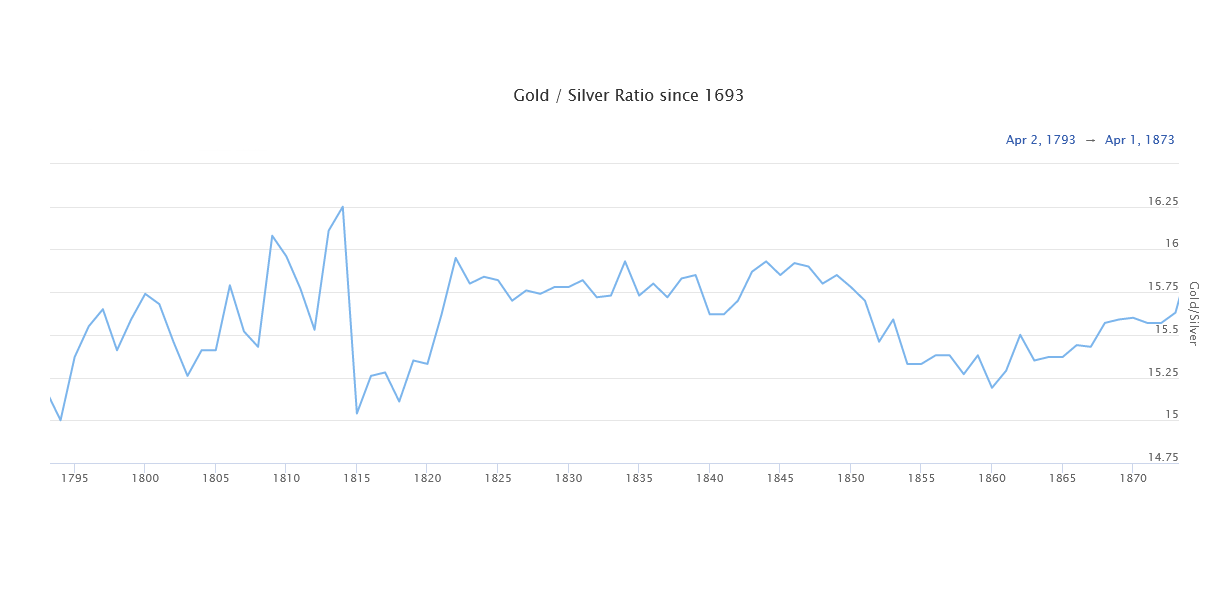
As you can see from the chart, the market price ratio of gold and silver was 15:1 only at the beginning of American bimetallism, at the time when Congress defined the fixed ratio.
Change of the fixed ratio - 1834
In 1834, the fixed ratio of silver and gold was changed from 15:1 to 16:1. This did not improve the situation in any way, on the contrary, it made it even worse, silver was undervalued against gold and disappeared from circulation.
Debasement of silver coins - 1853
In 1853, small silver coins (worth less than one dollar) were debased by 7%, so that they would not disappear from circulation because of Gresham's law. The debasement of coins that we know from history was thus back again.
American Civil War - 1861
The American Civil War took place between 1861 and 1865, so, as is customary, the government had to introduce fiat money. The government introduced the so-called greenbacks, which were nothing more than unbacked paper, so it could print as many of them as it wanted, rob the citizens, and finance the war.
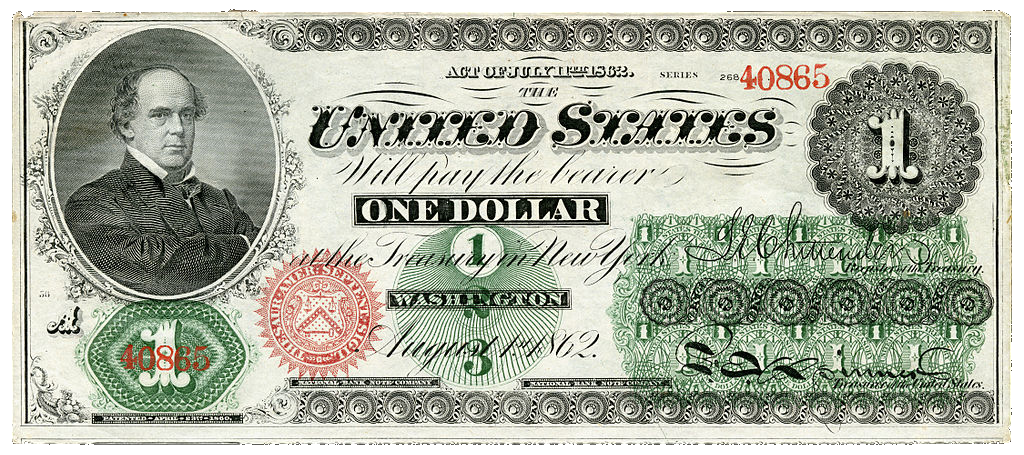
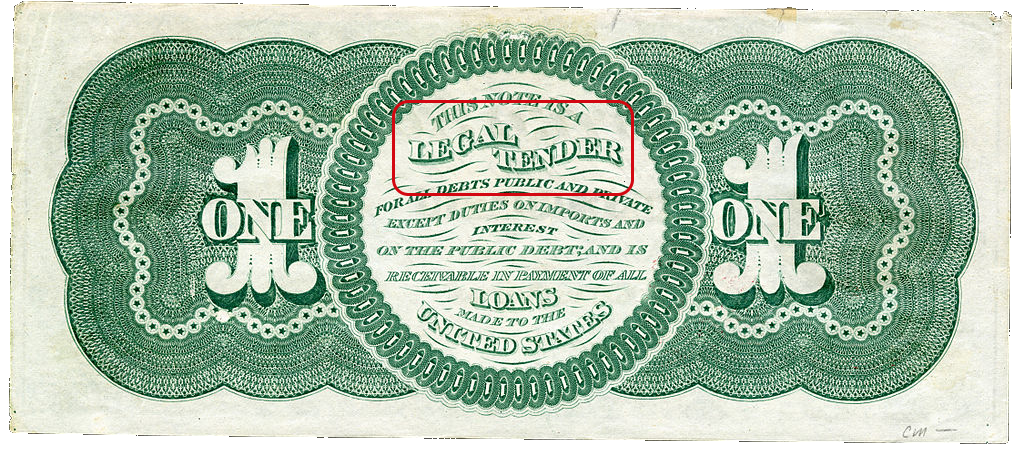
On these notes you will no longer find a sentence about convertibility into gold or silver. You will find the phrase legal tender on them, though, which means that a creditor must accept them as payment of a debt and cannot demand payment in gold or silver from the debtor.
The end of bimetallism - 1873
In 1873, the free coinage of silver dollars ended (until then, anyone could have their own silver minted into coins), bimetallism thus de facto ended, and the US gradually began to move to the gold standard, which was officially established in 1900.
The last definition of the gold dollar - 1900
In 1900, one dollar was defined as approximately 1.5 grams of gold. As you will soon read, however, the gold dollar unfortunately existed for an even shorter time than the silver one.
Federal Reserve System (Fed) - 1913
The long-standing motivation, and not only of bankers, was to create a central bank and move to unbacked paper money, sometimes called money backed by debt.
The Fed was preceded by 3 attempts at a central bank in America, but they all ended.
- Bank of North America (1781-1783), after the end of the Revolutionary War, the bank stops being supported by the government and becomes private.
- First Bank of the United States (1791-1811), the bank loses its charter, most of its shares are bought up, and it later becomes the new private bank Girard Bank.
- Second Bank of the United States (1816-1836), the bank loses its charter and becomes private.
Reasons for the creation of the Fed
From my point of view, there are three main reasons for the creation of the Fed - cartelization, lender of last resort, and debt-based paper money.
Cartelization protects existing banks from competition, from competition even coming into existence. If someone wants to compete with banks on the market, they first have to get a license from the state, have minimum capital, have the approval of the Fed itself, meet many other requirements, and comply with many other regulations.
Lender of last resort means nothing else than protection of a particular bank from bankruptcy, the Fed can support a bank in trouble by lending it newly created money.
Fiat money is, as we wrote earlier, a very good tool for governments and banks. It is a good tool because wealth can be very easily transferred from the hands of society into the hands of banks and the government.
Secret meeting of bankers - 1910
Before the creation of the Fed, in November 1910, Senator Nelson Aldrich and Assistant Secretary of the Treasury A. Piatt Andrew secretly met on Jekyll Island with representatives of the largest banks - Frank Vanderlip (National City Bank, linked to Rockefeller), Henry Davison and Charles Norton (both from J. P. Morgan's circle), Paul Warburg (Kuhn, Loeb & Co.), and Benjamin Strong (Bankers Trust).
The goal of these bankers was to create a system that would protect their banks from bank runs (a rush of a large number of depositors who come to withdraw their deposits from the bank). Since banks were already operating on a fractional reserve system at that time - they lent people more money than they had in reserves - they logically could not pay out all depositors during a run.
Ideally, the bankers would have wanted to establish a system of paper money based purely on debt, but they knew it was not popular at the time, so a lender of last resort that would always save them from collapse was "enough" for them.
To carry out this plan, however, the bankers needed to get the government on their side, which, as it soon turned out, was no problem at all, because the government knew that it could also profit from such a system. The government would not have to raise taxes if it had a practically unlimited source of money.
The constitutional safeguard and how to get around it
Thomas Jefferson often invoked the Tenth Amendment to the Constitution - the federal government has only the powers delegated to it by the Constitution - but he himself later found out that it can easily be circumvented when it comes to paper money.
The federal government is allowed by the Constitution to borrow. Thomas Jefferson rightly considered this unfortunate, and in 1798 he wrote that he wished for a constitutional amendment that would prohibit the federal government from borrowing.
Unbacked paper money, fiat money if you like, can therefore exist legally. The trick is that money is not created directly by the state, but by banks, through lending. When the government needs money, it issues government bonds, banks buy them with newly created money, that is, they "lend" money to the government, and the government starts spending it, thus sending new money into circulation. New money is created in the same way with every loan to a company or a household.
The word "lend" is in quotation marks because it is not really a loan of the bank's saved money, but the direct creation of new money. With every repayment, on the other hand, money ceases to exist, it disappears from circulation.
I have basically just explained how today's fiat money works all over the world, I have described how the US dollar, the British pound, the euro, or the Czech koruna work. The central banks themselves make no secret of the fact that banks create money through lending.
Let me show you the statements of 3 central banks, even the Czech National Bank admits it completely openly.
Original text:
Whenever a bank makes a loan, it simultaneously creates a matching deposit in the borrower’s bank account, thereby creating new money.
Original text:
Peníze vznikají typicky v momentě, kdy komerční banka poskytne nějakému člověku či firmě úvěr. Na účet takového klienta připíše banka částku ve výši poskytnutého úvěru a o takto vytvořený (či navýšený) vklad se ve stejném okamžiku zvýší i peněžní zásoba. Ano, chápete správně, banka nepůjčuje peníze, které má uloženy někde jinde (mysleli byste zřejmě, že nejspíše v centrální bance, že?), respektive nepůjčuje ani již existující vklady. Ve skutečnosti při poskytnutí úvěru vytvoří „tahem pera“ či ťuknutím do klávesnice peníze zcela nové, které tu dosud nebyly. A teď tu zničehonic jsou.
English translation:
Money is typically created at the moment when a commercial bank grants a loan to a person or a company. The bank credits the client's account with the amount of the loan, and the money supply increases by the deposit created (or increased) in this way at the same moment. Yes, you understand correctly, the bank does not lend money that it keeps somewhere else (you would probably think in the central bank, right?), nor does it lend existing deposits. In fact, when it grants a loan, it creates, "with a stroke of the pen" or a tap on the keyboard, entirely new money that did not exist before. And now, out of nowhere, it is here.
In 2017, the German Bundesbank explained that banks can create money with a mere accounting entry, and added:
Original text:
Das widerlegt einen weitverbreiteten Irrtum, wonach die Bank im Augenblick der Kreditvergabe nur als Intermediär auftritt, also Kredite lediglich mit Mitteln vergeben kann, die sie zuvor als Einlage von anderen Kunden erhalten hat.
English translation:
This refutes a widespread misconception that a bank acts merely as an intermediary when granting a loan, that is, that it can only grant loans using funds it has previously received as deposits from other customers.
Deutsche Bundesbank, Monthly Report April 2017
Creation of the Federal Reserve System - 1913
In 1913, the dreams of bankers and rulers start coming true, under the pretext of banking stability and protection against recessions, the Federal Reserve System was created. From now on, things will only get worse for the US dollar.
From now on, commercial banks are protected from new competition and from bankruptcy, but they still have to back the dollar at least partially with gold, which limits them in creating new money.
By the way, it is no coincidence that this institution is called the "Federal Reserve System" and not, say, the "central bank", because American society was still not very fond of European central banks and their paper money.
Credit expansion and its consequences - 1920
After the creation of the Fed, which among other things was supposed to maintain stability and protect against recessions, a big credit expansion began. This credit expansion caused the boom of the 1920s, companies were overvalued and stocks rose, but they rose above their real value. The money supply grew by roughly 60% between 1921 and 1929 (according to Murray Rothbard's calculation). Consumer prices stayed stable thanks to growing productivity, so the inflation showed up mainly in the prices of stocks and real estate.
The credit expansion had to start slowing down, which according to the Austrian school of economics always leads to a depression, in our case to the well-known Great Depression, which started with the stock market crash of 1929.
The problem of credit expansion by central banks in a fractional reserve system is explained by the Austrian business cycle theory.
Executive Order 6102 - 1933
On April 5, 1933, President Franklin D. Roosevelt issues Executive Order 6102, which orders all US residents to surrender gold coins, gold bullion, and gold certificates (except for jewelry, collector's coins, and gold worth up to $100 per person) by May 1 of the same year, otherwise they will face a fine of up to $10,000 (more than $200,000 today), 10 years in prison, or both.
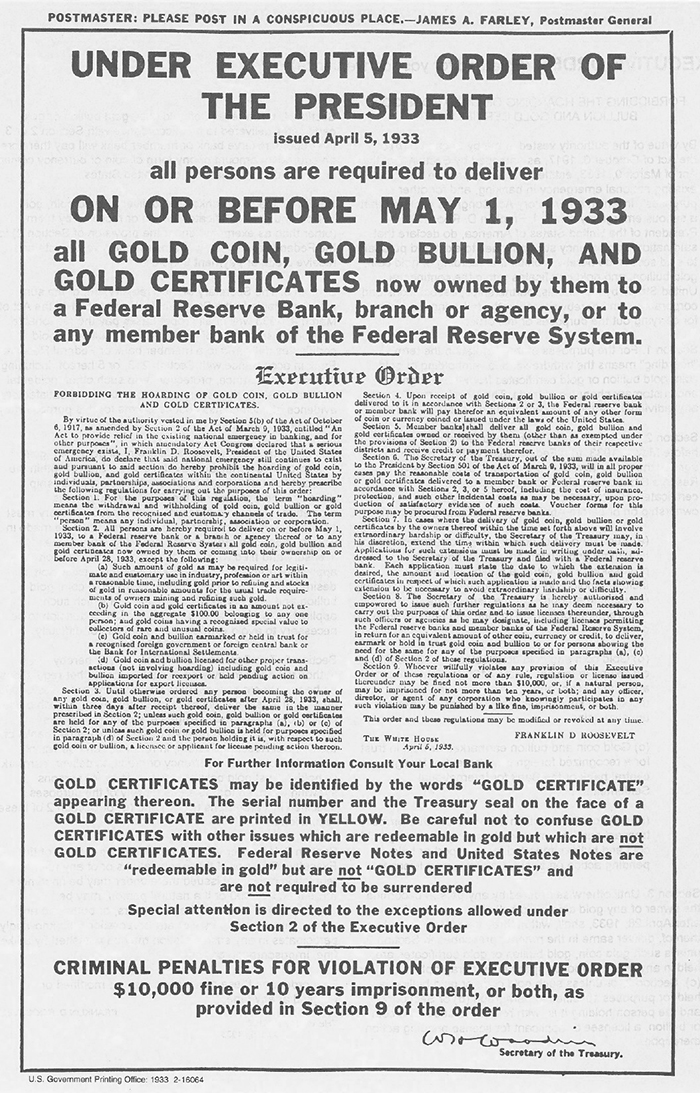
Sample of Executive Order 6102.
It seems completely illegitimate to me to take away everyone's gold, or rather force them to exchange it for unbacked paper money. Moreover, people received $20.67 per ounce of gold, and right in January 1934 the government raised the official price of gold to $35 per ounce with the Gold Reserve Act. The dollar thereby lost over 40% of its value against gold, and only after people had surrendered their gold at the old rate.
Even sadder is that some citizens tried to defend themselves in court, but no one succeeded. In 1935, the Supreme Court (in the so-called Gold Clause Cases) moreover confirmed that the government could cancel gold clauses in contracts, so debts agreed in gold could be repaid in devalued paper dollars. This only shows that the Constitution fails to restrain the government. The government can always get around the Constitution, it always finds a way, because in the end it is the only interpreter of the Constitution itself.
The greatest wish of the bankers and rulers is starting to come true, gold is no longer in the hands of citizens, but in the hands of the Fed. Banks can offer even more loans (create new money) and citizens cannot run on the banks (there is nothing to withdraw, gold is forbidden). The only thing that still bound the Fed was the obligation to back the dollar with at least 40% gold.
It has only been possible to own gold again since the end of 1974, but using it as money is still a problem in practice, attempts at private gold money ended in criminal prosecution (see Liberty dollar and E-gold).
Bretton Woods system - 1944
Even before the end of World War II, in July 1944, 44 countries agreed on a new monetary system. The essence of this agreement was to tie the US dollar to gold and all other national currencies to the US dollar.
Main terms of the system
- The US dollar was fixed at 1/35 of an ounce (≈ 0.89 g) of gold.
- Only governments, not citizens, could exchange US dollars for gold.
Consequence of the Bretton Woods system
The Fed always had to exchange dollars for gold at the fixed rate for every central bank. The problem arose when the US government began to create more and more paper money, the dollar was losing its value, and gold was thus artificially undervalued. The central banks of other countries logically reacted and started exchanging dollars for gold, which led to an outflow of gold from the US.
The United States government of course tried to stop the outflow of gold, to change the original Bretton Woods agreements, or to manipulate the market price (see London Gold Pool), but nothing stopped the outflow of gold.
The absolute end of dollar convertibility - 1971
Because of the outflow of gold from the United States, President Richard Nixon cancels the convertibility of the US dollar into gold even for central banks in 1971. The US dollar is completely unbacked, it is "backed" by debt, it becomes pure fiat.
The previous, bad Bretton Woods system is replaced by an even worse system, the US dollar is based on debt, other currencies are based on debt and hold the debt-based dollar as reserves.
US dollar based only on debt - 1971
We have briefly gone through the history of the US dollar - the situation before the dollar, the silver standard, bimetallism, the gold standard, the creation of the Fed, the creation of a banking cartel, the creation of a lender of last resort, the gradual move away from gold, credit expansion (creating new money), the confiscation of gold, the Bretton Woods system, the complete abandonment of the gold standard, and the current dollar based entirely on debt.
Since 1971, the US dollar has worked the same way as today, the US dollar is fiat money.
A few sad charts
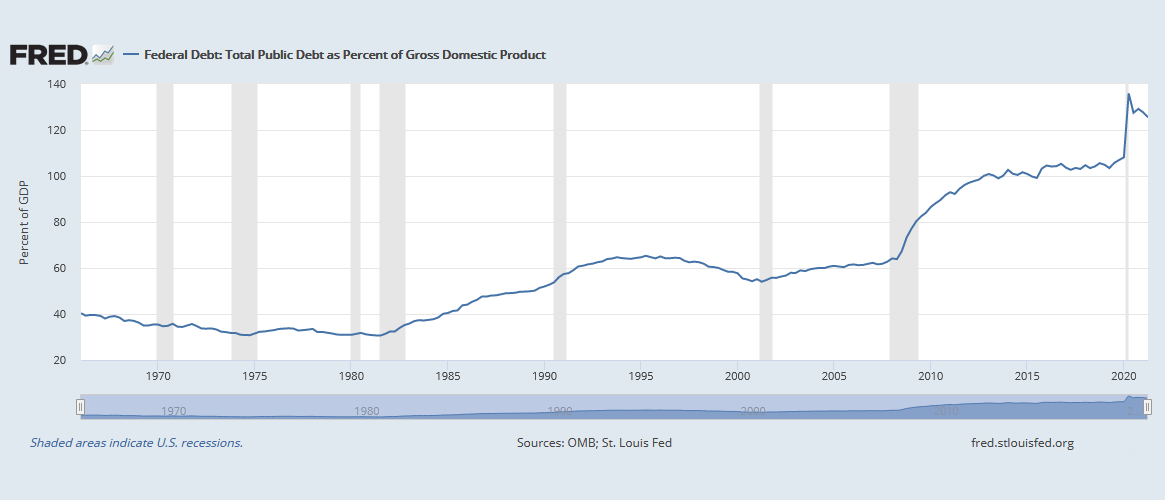
In this chart you can see the debt of the US federal government. Notice how high it keeps climbing since 1971, there is clearly no plan to ever pay off such a debt.
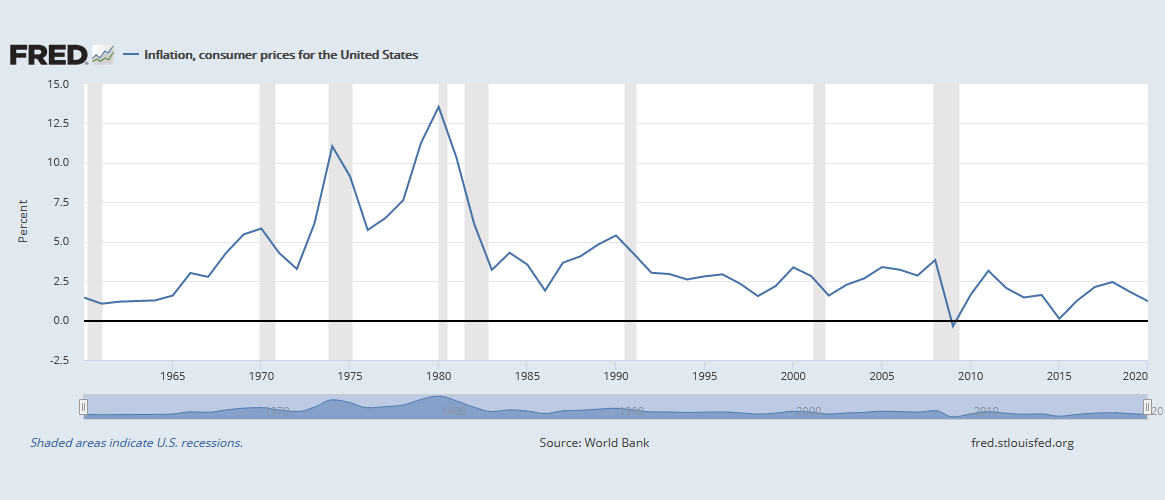
As you can see, a few times after 1971 the annual inflation was more than 10%, on average the annual inflation was about 3.9%. Inflation compounds from year to year, though (every year the already increased prices rise), so over these 50 years prices rose approximately 6.7 times, that is by roughly 570%.
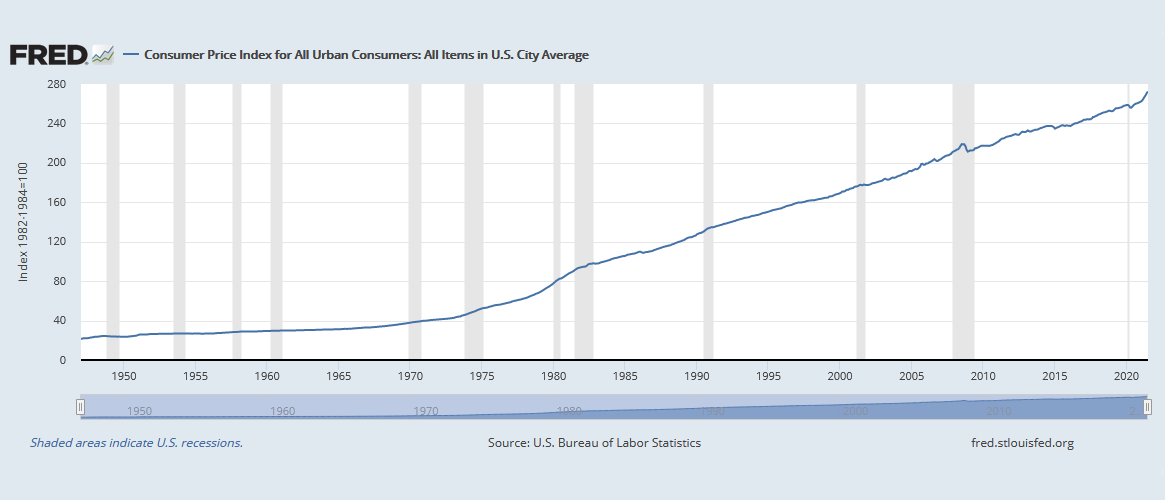
From the consumer price index chart we can see that the index has grown almost 7 times since 1971. That's what I call "beautiful" inflation.
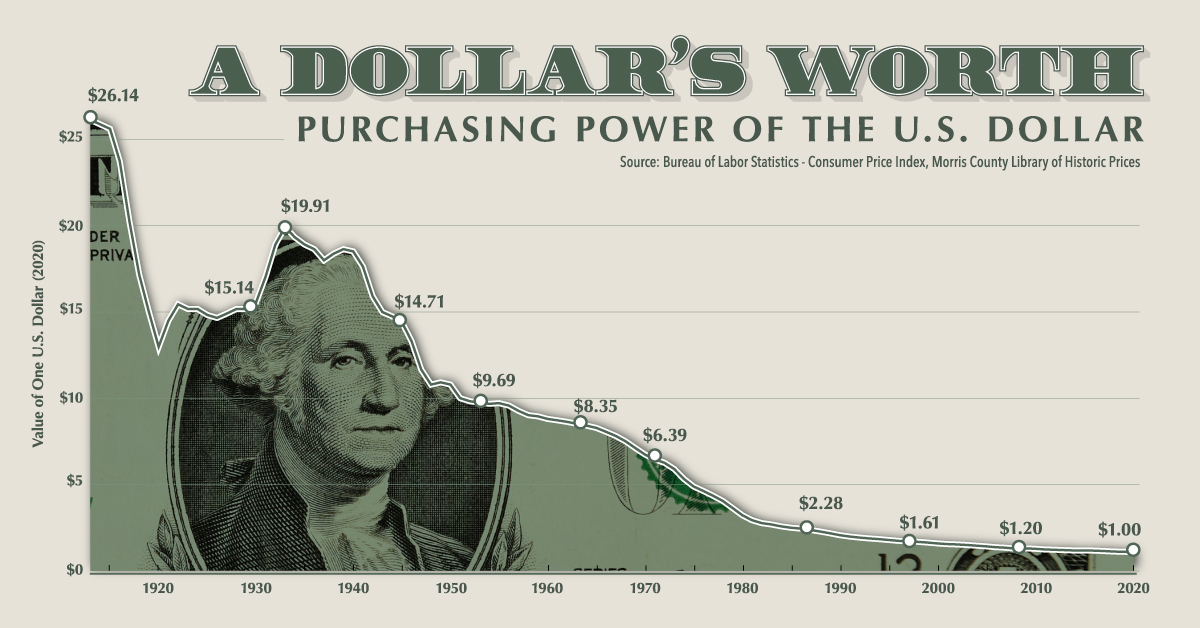
This visually pleasing chart shows how many 2020 dollars $1 from a given year corresponds to.
- 1913 - At the creation of the Fed, $1 was worth $26.14 in 2020 dollars.
- 1930 - After the great credit expansion and at the beginning of the Great Depression, $1 was worth $15.14 in 2020 dollars.
- 1933 - After the ban on holding gold, $1 was worth $19.91 in 2020 dollars.
- 1945 - After the arrival of the Bretton Woods system, $1 was worth $14.71 in 2020 dollars.
- 1971 - After Nixon abolished the entire gold standard, $1 was worth $6.39 in 2020 dollars.
Since the creation of the Fed, the purchasing power of the dollar has been falling in the long run (the exception was the deflation during the Great Depression), and since 1971 practically every year. You can see in the chart that in 1913, $1 was worth $26.14 in 2020 dollars, today it is already over $30, for the current value I recommend the dollar purchasing power calculator.
More charts can be found at WTF Happened In 1971.
Cantillon effect
After the arrival of money based purely on debt, it would be useful to look at the Cantillon effect.
You surely know that the more money banks create, the more inflation and prices will rise. The problem is that prices do not rise automatically and evenly after new money is created. Whoever prints has a considerable advantage, they can spend the new money while prices are still not increased. Rulers, banks, and other organizations close to the new money benefit from the Cantillon effect. The middle and lower classes, on the other hand, have no chance to benefit from this effect.
The Cantillon effect can also occur with precious metals, whoever mines new gold first can buy at prices that have not yet increased. However, this effect concerns mainly fiat money, because a central bank can create an unlimited amount of money at any time, while there is still a limited amount of gold on Earth, and it has to be found first.
Anyone who cares about average and poor people certainly cannot support the central bank, the state, and its monopoly on money. Thanks to this effect, inflation becomes a regressive tax - the poor pay the rich.
Fiat vs. gold
Throughout history, gold was mostly used as money, nowadays it is mainly fiat money. So let's compare fiat and gold.
| Fiat | Gold | |
|---|---|---|
| Durability | ✔ | ✔ |
| Divisibility | ✔ | ✔ |
| Transferability | ✔ | ✔ |
| Fungibility | ✔ | ✔ |
| Unit of account | ✔ | ✔ |
| Medium of exchange | ✔ | ✔ |
| Voluntary use | × | ✔ |
| Scarcity | × | ✔ |
| Long-term store of value | × | ✔ |
Fiat is by definition not voluntary, we all have to use it, which I consider a disadvantage.
The second huge disadvantage of fiat is its purchasing power, which falls every year, governments keep borrowing and banks keep creating new money. Because of this, fiat is not really a good store of value, it is not possible to save in fiat in the long run, whoever doesn't want to get poorer has to invest.
Bitcoin
Origin of Bitcoin - 2009
Whitepaper - 2008
On October 31, 2008, an individual or a group hiding under the pseudonym Satoshi Nakamoto publishes a whitepaper titled Bitcoin: A Peer-to-Peer Electronic Cash System.
In the whitepaper, he points to the main disadvantage of existing electronic payments, and that is trust in a third party (financial institutions). Fiat and gold have the same problem, though. Whether it is sending money electronically or storing gold in a bank, we always have to trust a third party. We know from history that third parties abuse their position sooner or later.
What is needed is an electronic payment system based on cryptographic proof instead of trust, allowing any two willing parties to transact directly with each other without the need for a trusted third party.
Satoshi then wrote his criticism of fiat quite openly a few months later, when he was introducing Bitcoin on the P2P Foundation forum.
The root problem with conventional currency is all the trust that's required to make it work. The central bank must be trusted not to debase the currency, but the history of fiat currencies is full of breaches of that trust.
Satoshi Nakamoto, P2P Foundation, 2009
In the whitepaper, he further explains how this P2P system will work, how transactions and blocks will work, what proof-of-work is and why it is so important, how the network will work, the motivation of miners and the related reasons why the network works, how to store all transactions publicly in an efficient way, how all transactions will be verified, what the anonymity of using Bitcoin is like, and finally he explains the calculations and chances of an attacker destroying the network.
Network launch - 2009
Satoshi Nakamoto fulfills the words of the whitepaper and on January 3, 2009, he creates the first, so-called genesis block. He put a headline from that day's edition of The Times into it: "Chancellor on brink of second bailout for banks", which clearly shows what Bitcoin was created against. On January 9, 2009, he then releases the first version of the software and launches the Bitcoin network, a network that is still running today. It is still running because it does not depend on a single central point, it is decentralized, any of us can have all Bitcoin transactions stored on our computer, and they are the only thing we might need to restore the network.
What is Bitcoin?
I'm sure quite a few of you reading this think that Bitcoin is a (crypto)currency. But that's not true, Bitcoin is (crypto)money. Bitcoin is not backed like a currency, Bitcoin is the backing itself, like money.
Bitcoin logo.
Bitcoin is electronic, non-state money. It is money that does not need any third party, unlike fiat or gold. No bank, no state, no authority can control Bitcoin, change it, or shut down the network. A state can ban the use of Bitcoin, as China did in 2021, but the network keeps running and the miners simply moved elsewhere.
You can't fully understand Bitcoin in one day, and this article hardly covers Bitcoin from the technical point of view at all, if you are interested in how Bitcoin works, you can read a little about transactions and mining.
Fiat vs. gold vs. Bitcoin
| Fiat | Gold | Bitcoin | |
|---|---|---|---|
| Durability | ✔ | ✔ | ✔ |
| Divisibility | ✔ | ✔ | ✔ |
| Transferability | ✔ | ✔ | ✔ |
| Fungibility | ✔ | ✔ | ✔ |
| Unit of account | ✔ | ✔ | ✔ |
| Medium of exchange | ✔ | ✔ | ✔ |
| Immateriality | ✔ | × | ✔ |
| Voluntary use | × | ✔ | ✔ |
| Scarcity | × | ✔ | ✔ |
| Long-term store of value | × | ✔ | ✔ |
| Absolute scarcity | × | × | ✔ |
| Decentralization | × | × | ✔ |
| Working without a third party | × | × | ✔ |
| Antifragility | × | × | ✔ |
| Predictable monetary policy | × | × | ✔ |
| Fair issuance of new money | × | × | ✔ |
Bitcoin and its advantages
Absolute scarcity
You can see from the table that Bitcoin is the only one that is absolutely scarce. This is because Bitcoin is set up so that there will be at most 21 million bitcoins in circulation (to be precise, slightly fewer, 20,999,999.9769), there will never be more, on the contrary, some will rather get lost.
Of course, there is also a limited amount of gold on our Earth, but we still haven't mined all of it. In the distant future, it is also possible that we will mine gold outside our planet, which will result in a decrease in the value of gold.
Immateriality
Bitcoin stands out for its immateriality, which is definitely an advantage. Fiat is immaterial too (most money today exists only as an entry at a bank), but a third party holds it for us. Unlike gold, we don't have to store bitcoins in banks, we don't have to carry them around in a complicated way, and no one can easily take them away from us (the experience of 1933).
Decentralization
Decentralization, and the related operation without a third party, is one of the biggest advantages of Bitcoin. Our experience from history is that a third party abuses its position sooner or later, rulers debased coins and banks lent more than they had in reserves.
Besides seizure being difficult or even impossible, getting started with Bitcoin is an advantage in itself. Just download any software wallet and start receiving or sending bitcoins. No one can stop you from using Bitcoin in any way, the way it can theoretically happen with a bank account, which is provided precisely by a third party.
Antifragility
Bitcoin is the only one that is antifragile, which means that it does not get weaker from shocks and attacks, on the contrary, it gets stronger. Every attack and every internal dispute makes Bitcoin more resilient, in short, better.
A good example is the Chinese mining ban in 2021. China hosted most of the miners at the time, and the computing power of the network (hashrate) dropped to roughly half within a few weeks. The network kept working, within a few months the hashrate returned to record levels, and mining is now geographically much more spread out than it was before. The internal dispute over the block size (2015-2017) ended in a similar way, with the activation of SegWit, showing that not even a large group of companies can change Bitcoin's rules without the consent of its users.
Gold is certainly not antifragile, gold only resists attacks well, but it has not been able to defend itself against abuse by states and central banks. It failed to defend itself precisely because of the need for a third party.
Monetary policy
Unlike gold and fiat, Bitcoin has a predetermined supply.
Only with Bitcoin do we know
- How often and how many new bitcoins will come into circulation (a new block is created approximately every 10 minutes and the reward for it is halved every 4 years, the so-called halving)
- When the last bitcoins will be mined (around the year 2140)
- The maximum number of bitcoins in circulation (21 million)
With gold, we don't know when and how much of it will be mined, and looking into the future, we don't even know the maximum amount in circulation.
With fiat, we don't know anything at all, the money masters will probably never stop creating new money.
Fair money
Unlike fiat, Bitcoin practically does not suffer from the Cantillon effect. New bitcoins are received first by miners, similar to gold, but their amount is small, known in advance, and no one can change it. The market can therefore price it in ahead of time, and no one can create new bitcoins "out of nothing" and spend them before prices react.
Moreover, miners of course don't get new bitcoins for free, they get them for the work they do - for burning electricity (proof-of-work).
Bitcoin is the fairest money - new bitcoins come into circulation regularly and transparently, they are not received by some central power, but by the miners who keep the network running.
Bitcoin and its temporary disadvantages
Volatility
The price of bitcoin is set by the market, so it depends on people's demand. The problem is short-term price swings (volatility), which can happen because of Bitcoin's small market capitalization.
At the time of writing (October 2021), Bitcoin's market capitalization was "only" 850 billion dollars (850,000,000,000). For comparison, the market capitalization of gold was approximately 11 trillion dollars and that of all the world's stock markets over 100 trillion dollars (100,000,000,000,000). To get a good idea, I recommend taking a look at companiesmarketcap.com.
Bitcoin still has a small market capitalization, so many things can still push the price of bitcoin up or down. The higher Bitcoin's market capitalization gets, the lower its volatility will be.
Lindy effect
The Lindy effect is a theoretical phenomenon which assumes that things that have worked for a long time will keep working for just as long. According to the Lindy effect, we can assume that gold, which has worked as money for thousands of years, will keep working for thousands more.
Bitcoin, however, has the problem that, compared to gold, it has been with us (at the time of writing) for only 12 years, humanity has not yet gotten used to it the way it has to gold. This problem logically gets smaller every year, the longer Bitcoin works, the more people will trust it.
Bitcoin and its "problems"
Illegal activity
Especially in the past, Bitcoin was criticized for its anonymity and the illegal activity associated with it.
Such criticism, however, comes rather from not understanding Bitcoin from a technical point of view. Bitcoin is not anonymous, but pseudonymous.
All transactions are publicly available to everyone - we don't know who is sending and receiving bitcoins, but we do know from where to where they are sent.
Bitcoin is not very suitable for criminals, cash is still the most suitable. The data confirm this too, according to the analytics company Chainalysis, illegal transactions have long made up less than 1% of the volume of all cryptocurrency transactions, in 2024 it was 0.14%. Moreover, most of them don't happen in Bitcoin, but in stablecoins (source: Chainalysis, 2025).
Ecology
Looking at Bitcoin from an ecological point of view is relatively new, but here too we mostly run into a lack of understanding of Bitcoin, this time both technical and economic.
Miners are increasingly switching to surplus energy and energy from renewable sources, because it is cheaper. According to a 2025 study by the University of Cambridge, 52.4% of the energy used for Bitcoin mining already comes from sustainable sources (42.6% renewables and 9.8% nuclear), compared to 37.6% in 2022. Over the same period, the share of coal fell from 36.6% to 8.9% (source: Cambridge Judge Business School, 2025).
However, for the following facts we can safely consider any energy automatically non-ecological (even though it isn't), and I will still consider Bitcoin more ecological than its competition.
We run into the economic side of things - who is Bitcoin actually competing with? Not only these people mistakenly think that Bitcoin competes with entities like PayPal or Visa, if that were the case, Bitcoin would indeed be less ecological. But Bitcoin doesn't compete only with some payment systems, Bitcoin competes with central and commercial banks, mints, printing presses, the payment systems mentioned, and theoretically with the security forces that enforce fiat.
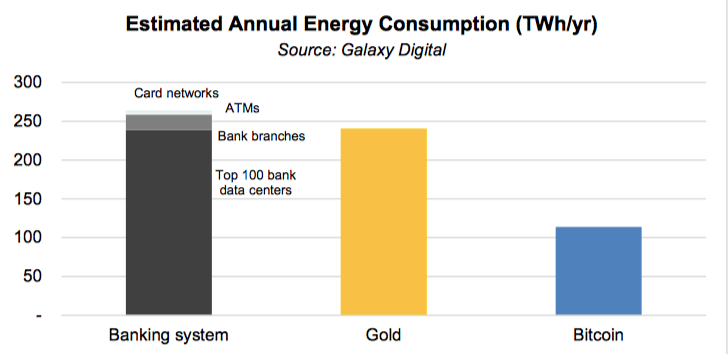
According to a 2021 estimate, the banking system consumes approximately 2x more energy than Bitcoin (263.7 TWh compared to 113.9 TWh per year). Source: Galaxy Digital.
Bitcoin is more ecological than the current monetary system.
The second thing some critics of Bitcoin don't understand is mining itself and its purpose. Most know that miners mine new bitcoins, which is true (for now), but they don't know that miners mainly confirm all transactions, so that the network is secure and there is no so-called double spending.
While confirming transactions, every miner also has to burn electricity, so that cheating doesn't pay off for them (the concept of the mentioned proof-of-work). If we consider any burning of electricity non-ecological, then in that case Bitcoin is, and above all has to be, non-ecological.
Finally, I would like to tell all ecological critics the main fact - burning electricity does not depend in any way on the number of users or on the number and size of transactions, burning electricity depends on the number of miners.
Objective value
A common objection is that Bitcoin has no objective (intrinsic) value. But there is no such thing as objective value, value is a subjective concept.
The subjective theory of value was introduced in 1871 by Carl Menger, the founder of the Austrian school of economics (William Stanley Jevons and Léon Walras came to similar conclusions independently of him). Menger's student Eugen von Böhm-Bawerk later built his critique of Marx (1896) on this theory, which in my view refuted Marxism on a theoretical level, because Marxism is based on the labor theory of value.
That the subjective theory of value is the best one is nicely shown by the paradox of value, already described by Adam Smith - water is essential for life and yet it is cheap, we don't need diamonds for life and yet they are expensive. The paradox was only resolved by the theory of marginal utility, the price is not determined by the total usefulness of a thing, but by the utility that its next unit brings to people.
So Bitcoin doesn't need any "intrinsic" value. Just like gold, or any other good, it has value because people consider it useful, in its case as scarce, unconfiscatable money independent of any third party.
Conclusion
Fiat money is not voluntary, it is not backed by anything, and its purchasing power falls in the long run, moreover, new money benefits mainly those who are closest to it. The history of the US dollar shows how money broke away from gold step by step, until it became pure fiat based on debt.
Gold is much better as money, but its weakness is the need for a third party that stores and transfers it, and that is exactly what allowed states and central banks to take it away from people in the past.
Bitcoin takes the best from gold - scarcity and independence from the state - and adds absolute scarcity, a predictable monetary policy, and working without a third party. Its temporary disadvantages, volatility and short history, get smaller with every year it keeps working.